
“Hogg” is a reference work describing in detail all the known apple varieties in 1884, it is useful when trying to identify heritage apples. There is an entry for the Wareham Russet in the 5th Edition of the Fruit Manual by Hogg, published 1884.
A tree at Tower Lane in Weaverham was identified by Tony Gentil to be the heritage Wareham Russet of Hogg. Tony Gentil was formerly deputy head of horticulture at Reaseheath and was recognised as one of the country’s leading experts on orchard fruit. It has been propagated locally into community orchards and has become something a a local prize. The original tree is likely not very old, perhaps not even pre-WW2, unlikely pre-WW1.
Tom Adams ( Tom the Appleman) https://tomtheappleman.co.uk has a nursery. He specialises in hard to find heritage apple varieties from the English/Welsh borderlands and is building a collection of local varieties from all over the country.
Stephen Ainsleigh Rice, of the Marcher Apple Network ( MAN ), submitted a sample supplied by Tom from a Wareham Russet for DNA analysis. I am not sure if this was from stock obtained from Tony Gentil or if was from a scion ( cutting ) taken from Tower Lane ( Tom had grafted some scions for the Memorial Orchard and retained some for his own use). To Ainsleigh’s surprise the sample was identified as Lemoen, a Dutch variety.
Two years later this was confirmed by analysing leaf samples taken directly from the tree in Tower Lane. Care was taken to ensure that the samples were taken from the same branch that Tony Gentil identified as a Wareham Russet.
The timeline indicates why the Lemoen can not be the same variety as the Wareham Russet: See:
https://orchard.weaverham.org.uk/timeline/
The following is copied from correspondence between Stephen Ainsley Rice, Tom Adams, myself (Steve Doughton) and others. It has been edited to improve readability. Some of it is rather technical.
In April 2023 Stephen Ainsleigh Rice wrote to inform the Memorial Orchard of the results of DNA testing on Tom’s sample:
“In the Marcher Apple Network ( MAN ) we have built an extensive collection of varieties from the Welsh Marches and beyond. We take care with identification, as Tom will vouch. DNA SSR results of apples obtained via the fruitID campaigns are used extensively for identification and parentage assessment. Through Tom Adams we had scions of the ‘Wareham Russet’ that I think was from your Memorial Orchard. We had leaves fingerprinted in 2019 as sample A3348. It returned a match to the Dutch variety Lemoen held at the NFC 1949-083. This was received at NFC in 1949. Do you know if the tree from which you sourced scions (probably by Tony Gentil) is(was) ‘old’ even in 1949 or had been grafted up from old trees growing locally? If so the Dutch accession might be in error.
“Also there is listed two other trees you have in the memorial orchard, Arthur W. Barnes and Millicent Barnes. Both are suggested as progeny of Cox’s Orange Pippin x Gascoyne’s Scarlet. DNA SSR shows that Cox’s is likely correct, but Gascoyne’s is not consistent (i.e. not possible). Instead the second parent is probably Bismarck. This error may have arisen as a result of the anti-German feelings during and after the First World War, when the apple Bismarck was ‘suppressed’.
On the 25th April he wrote:
I never met Tony Gentil, sadly he died before I became active in MAN. His reputation was high, folk regarded him very highly. I’m therefore pre-disposed to take his views very seriously.
Tom are you sure that the scions you grafted up for MAN are indeed of the Wareham Russet? It was grafted on M26. I planted it on 17Feb21 at location Ty Glyn E46. Is it possible that something else could have sneaked, though it’d be surprising if it was a fair morphological likeness also. There are no other accession of Lemoen in MAN’s orchard. Its not been found by anyone else in UK, yet.
DNA SSR of A3348 is pretty certain triploid, there are six of twelve markers tri-allelic. Like many triploids, it could well be a good variety as noted. It is likely a poor source of pollen and seeds in fruit are likely to be weak as saplings. This is exactly as to be expected of other triploids Belle de Boskoop and Notarisappel.
Cost of SSR is £40 per sample and administered by fruitID fruitID | Apple Identification | Apple Varieties | Apple Cultivars Yes, I think it’d be very helpful to submit one or two samples (eight dry leaves in a bag that Peter Laws will send to you) in May or June. At some stage it’ll be sensible to include the leading light behind it, Peter Laws. Probably we should include Dr Matt Ordidge the curator of NFC. Both are very helpful and are likely to be fascinated too.
I do have a little doubt that Hogg’s description of Wareham Russet is a good match to the NFC photo and description you found. It’s close, but Lemoen is larger, it is slightly conical rather than round, is regular and doesn’t seem to have much of a crown Hogg has it as with 4 or 5 more or less prominent ridges), and has stripes of a brown-rusty colour rather than a red cheek. The funnel of Lemoen is more a cone than as WR funnel, stamens nearer basal than median, segments of Lemoen seem more convergent with reflexed tips than erect and divergent at points (though I grant Lemoen eye looks fairly closed, Lemoen cavity is narrow, not remarked upon under WR. I grant that basin, stalk are close. Tantalising, but on morphology alone I rather doubt that Lemoen can be mistaken for WR.
Now there is another concern that I have. Looking at the DNA SSR is helpful to get an impression or connected varieties. Peter and I developed a tool Explorer-P2P that finds matching samples and possible parents. When I seek parents of Lemoen I find a number of plausible parents, some diploid and some triploid varieties. The latter are very unlikely given their low fertility, but they might be siblings or cousins. Here’s the list of closest matches:
- Reinette Coulon
- Reinette de Cuzy
- Present van Holland
- Bielaar
- Dutch Mignonne
- Present van Engeland
- Horneburger Pfannkuchen
- Notarisappel
- Pomme Jérusalem
and it isn’t very far from Belle de Boskoop. These are largely of Dutch origin. Incidentally Exploer-P2P gives Notarisappel with progeny of Florianer Rosenapfel as diploid donating gamete and Dutch Mignonne as haploid donating parent (and this is confirmed from a recent DNA SNP study). I can’t find parents for Lemoen, nor was it studied in the SNP work of Nick Howard et al.
Howard, N. P., Micheletti, D., Luby, J. J., Durel, C.-E., Denancé, C., Muranty, H., Ordidge, M., &
Albach, D. C. (2022). Pedigree reconstruction for triploid apple cultivars using single nucleotide polymorphism array data. Plants, People, Planet, 1–14. https://doi.org/10.1002/ppp3. 10313
But, the SSR similarity of Lemoen to diploids such as Dutch Mignonne, Present van Engeland, Present van Holland, suggest any couldof those be a haploid parent, and the similarity with Notarisappel and Belle de Boskoop hints that they might be related. Overall, I rather feel that Lemoen likely has Dutch parentage rather than UK in late C18 or early C19.
We’ve never before had a case where two apples of different morphology have the same SSR fingerprint, but I’m actually keen to find an example to challenge the faith in this methodology. I believe we should be starting to use SNP (similar cost, more complex data analysis).
Now Dutch Mignonne was brought to England about 1771, so perhaps it was used to breed WR fairly soon afterwards. But then would it have been lost in UK yet exported to the Netherlands, somehow found by Dhr van den Ham and claimed to be bred by him? Afterall Dhr van den Ham bred Notarisppel and this seems to have a perfectly reasonable SSR pedigree of varieties that were then well known and available. Some breeders records I really doubt, indeed some are just rubbish; not this case.
The key thing is are your trees also Lemoen? SSR will almost certainly answer that. There just might be a chance to do SNP this year for probing somewhat further.
Is there any evidence of a Dutch connection with the folk that lived at the cottage in Weaverham? I doubt that you can ‘eye’ the age of an apple tree. I can imagine it as 100 years, but I don’t think you can have confidence it is 150. Just because there was an apple tree at a given location 150 years ago, doesn’t preclude it died 140 years ago and was replaced with something different 120 years ago. Are the records that detailed, are their photos to support it? Very old apple trees often fall over and get a burst more growth energy as a phoenix, this hasn’t. Perhaps if the tree dies or has to be pruned more, tree rings could be counted. This could be helpful.
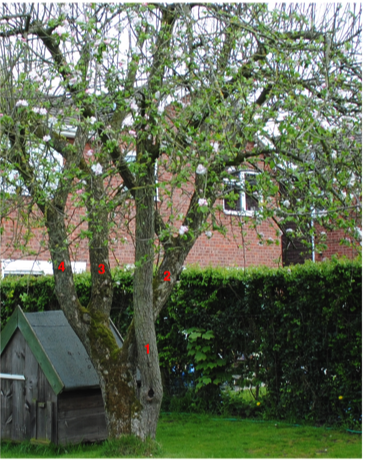
On the 13th June 2023 I took leaf samples from the tree in Tower Lane today. The samples were taken from branch 4. The owner told me that this was the branch that Tony Gentil identified as a Wareham Russet, and from which he took his scions.
I took samples from branches 2 and 3 too, and compared the leaves and immature fruit. To my untrained eye they look identical. I have taken some photos which you should be able to access through this link to Google Drive: https://drive.google.com/drive/folders/10qoHfbhUWrwFUspRLUDX51LEaaGAryqY?usp=sharing
( Visual comparison and tasting of the apples had confirmed that stems 2, 3 and 4 were identical. Stem 1 was removed before the leaves were taken. Stem 1 was the only stem that could possibly have been from below the graft on to the rootstock.)
I would appreciate your opinion on the photos. The leaf samples are IMG_4158 onward, the others are photos of the tree. As you can see, branch 1 has been removed. There were a few small leaves on a twig that has grown from branch 1, one of which photographed.
I have leaf samples from branches 2 and 3 in my refrigerator, but I do not think it is necessary to submit them.
Nearly one year later, on the 24th May 2024, Ainsley visited NIAB Analytical Services in Cambridge to review progress with their DNA Analysis provision.
The situation is that the DNA from our samples is safely stored under cryogenic conditions. However, there has been a malfunction in their ABI Analyser and after a site visit by an engineer from the manufacturer last Tuesday, the equipment has been deemed to be beyond economic repair. NIAB have consequently arranged to outsource this step of the analysis and I quote:
“Source Bioscience is right next door here at NIAB in Histon and we’ve arranged with them to use their ABI.”
14 months later on the 5th October 2024, while still waiting for the samples to be analysed, Ainsley wrote :
Dear Stephen,
I’ve been thinking of your kindly correspondence on the tree at Tower Lane in Weaverham. As the 3 apples on the cordon I have has now been picked I though you might like to see them. Very odd, but they are from deep inside the leaf cover so don’t develop much colour or russeting. Not a close match to the image on the NFC website and not good in comparison to Hogg’s Wareham Russet either.
The DNA results from NIAB are still awaited. NIAB has agreed to repeat the whole set of submissions made last year, this time including reference samples for calibrating elution times. Peter Laws suggest they may come in November or December. I suppose some sort of Christmas present! But a significant headache for him. I had a look at the preliminary result of your samples A5884 based upon some nifty work that Peter tried. Part of it matched Lemoen SSR, but there were nearly half the alleles that didn’t quite. This was a pervasive problem in the preliminary results, the reason for a complete repeat of the analysis. Thus I take the partial match as indicative that the Tower Lane sample is more probably Lemoen than not. We must wait another 2-3 months patiently.
Now, if you can revisit Tower Lane, it’d be handy to check whether fruit on each of the four stems are similar or different. Also take a few photos of samples too, side on, of the top and bottom. My colleague and ID mentor Mike Porter is willing to have a look at samples. I’ll be passing through your way in mid December so could collect then to show Mike (Hogg describes Wareham Russet as keeping till Christmas). Alternatively I have colleagues living in and near Shrewsbury who I’ll be seeing on 9th November who could safe hand them on if you can get them to Shrewsbury. Alternatively you’re welcome to post samples to me.
best wishes,
Ainsleigh
On the 7th October I replied.
Dear Ainsleigh,
Thank you for continuing to pursue this mystery, despite the problems.
All three surviving branches had very similar fruit. Branch 1 ( the one low down, that might have come from below the graft ) was removed last year.
I took 3 apples from each branch and took photographs of them. Two from each branch I cut up, one vertically, the other horizontally, and have taken photos of these too.
I still have one apple from each branch. I don’t think they will keep until December, winters are not as cold as they used to be. Not that many years ago I used to buy trays of apples from Eddisbury Fruit Farm and keep them in my shed until Christmas, but I can’t do that anymore. Do you want me to send them to you by DPD?
I tasted the apples that I cut up. They were all crisp and a good mix of sweetness and sharpness. They were sharp enough to leave a distinct tingle, almost a fizzyness, on the tongue after eating. I liked them. Would make good dual-purpose eater/cooker apples.
I also took some pictures of apples from some of the trees at the Memorial Orchard. There were not many left! All but one of these were windfalls so probably a bit riper than those from Tower Lane, which were all picked from the tree. The designation, e.g. K2, indicates an apple in row K, 2 trees in from the main path.
I don’t think any of the apples were from trees grafted by Tom the Appleman.
Regards
Steve Doughton
On 8th October 2024 I sent a box of apples to Ainsley for visual comparison.
Due to instrument failure the results were not returned until 11th January 2025. However the plus side of this was that the analysis with the new instrument gave a lot more information about the relationship of the sample to other apple varieties.
Sample A5884 was the sample submitted from Tower Lane direct to the NIAB for analysis. The results was a match to Lemoen.
Photos of samples taken by me ( Stephen Doughton ) looked similar to the NFC photo of Lemoen.
Ainsleigh noted that DNA of Lemoen does seem to have some ‘links’ with a number of Netherlands or nearby varieties:
- Reinette Coulon
- Reinette de Cuzy
- Present van Engeland
- Present van Holland
- Horneburger Pfannkuchen
- Notarisappel
- Bielaar
- A4000
- Notarisappel
- Reinette des Vergers
- Dutch Mignonne
- A5924
- Pomme Jérusalem
That seems to suggest its parents or relatives are Dutch.
Peter Laws confirmed the identification:
Just as an initial confirmation of the basics, I have pasted the 1949-083 row from Matt’s original source file “DNA Apple UK NFC – SSR all data for supply 14_10_10.xlsx” back into the target line of Explorer and it is exactly consistent (as I would hope !) and INRAE gave it MUNQ 885 for which there are no records other than these four shown here. INRAE preferred name is Lemoen. The CRAW-1015 is also MUNQ 885 but was derived from our Explorer translator from the reference 17-SSR fingerprint so hasn’t (yet) picked up the MUNQ 885 but I have shown the MUNQ entries below

Dr Matthew Ordidge
Department of Crop Science
School of Agriculture, Policy and Development
University of Reading
Whiteknights
Reading
RG6 6EU
Tuesday, February 4th 2025,
From a quick look at our database:
The NFC has supposedly held two accessions under the name Lemoen. The one we currently hold came from a Barron Van Haeften of… …Marlborough in Wiltshire. This has been looked at by my predecessors and felt to match with a “plate” in Onze Appels (I surprisingly found a potential link). I’m not sure about the plate, but the description appears similar to what we have. It was also noted to agree with a description in “the Dutch Catalogue”. The other NFC accession (no longer extant) came in from Morton-Shand (apparently with the name on). I presume this could indicate that it was around in the UK at the time. Oddly(?) they came in during 1947 and ’49, with the Morton-Shand one being first. I don’t know whether the second may have been sourced for comparison or if this is just coincidence.
Noting the below, there are also accessions listed at Wageningen, Holovousy (CZE) and Belgium – and the CRA-W listing (by name) is actually CRAW-1024. I don’t know whether this latter one could reflect a handling error in the MUNQ data. I know the curators at all three – so could try and enquire (but I don’t have access to the MUNQ tables at the moment) – interesting to see that CRAW 1024 is not listed under this name in the data in Explorer (and doesn’t obviously indicate a direct swap).
There is also an accession under the name Lemoen in USDA that went there from Wageningen (in 1947). It looks a little odd in their image (at least a bit small and long of stalk). From a very (very) superficial look at their fingerprint data (which have very few overlapping markers) it is not obviously out of alignment with ours (but only based on three markers).
None of the above (including NFC) reports having, or having had (in the NFC case) any accessions of Wareham Russet (which I think largely excludes the likelihood of a propagating/labelling error at Wisley/Brogdale).
On that basis, I think it’s worth us checking whether the NFC accession stands against other European examples, but I would imagine that a fairly strong case might be needed to justify considering a name change. It seems a stretch to think that Wareham Russet might have found itself to Holland to be ‘rediscovered’ and marketed as a seedling find in 1899.
Stephen Ainsleigh Rice replied:
That was most kind of you to find out so much about the background, Matt. It does confirm that the DNA and morphology of samples submitted from trees at Weaverham are consistently matching samples accessed in UK, Netherlands, Belgium, Denmark and US. And that accessions were made just after WWII, at a time of an optimistic opening up of national resources. From the pictures that Stephen has shown to me I’d feel the original tree at Tower Lane likely dates from that period. Despite some inconsistency in historical accounts of Wareham Russet, I feel that the Weaverham trees do not match it well, on size, shape, crown, flush. They match better to Lemoen, though even for this there appear difference in photos such as stalk length. DNA rather supports a Dutch connection.
As you note, Matt, it is a hard case to argue that Wareham Russet came from Netherlands to Cheshire, got named Wareham Russet in C19, went back to Netherlands and was named Lemoen in 1899. And the breeder in Netherlands, J H van Ham, was to my limited awareness both diligent and careful (he was not a Wastie!). I think much more likely the situation is that as yet Wareham Russet is a lost variety and that the tree in Tower Lane was mis-identified, understandably coloured with some hopes. I make that suggestion having done just that more than once.
Stephen, it might be helpful to ask Alan, I think it is who lives in Tower Lane, if his house deeds give a name of who owned the house during and after WWII. From that it might be possible to find a Dutch connection. Perhaps the tree was given by a grateful Dutch family in remembrance of something associated with the War? Would you like my assistance in discussions with your neighbours and Weaverham Community to explain why the identification as Wareham Russet can not be supported?